- Le(s) calcul(s) – The calculation(s)
- Les symboles manifestés – The manifested symbols
- S’abandonner jusqu’où ? – How far should one surrender?
- Une autre correspondance – Another correspondance
Le(s) calcul(s)
Qu’est-ce qu’une carte de l’année ? Je vous donne ici ma propre réflexion construite sur diverses influences notamment Akron et Banzhaf (Der Crowley Tarot) et Jodorowsky et Costa (La voie du tarot).
Le choix de la carte de l’année est le fruit de la somme des chiffres suivants : le jour, le mois de son anniversaire respectif et l’année présente. Exemple : 22 + 08 + 2025 ou encore 2+2+0+8+2+0+2+5. Les deux ne donnent pas le même résultat, soit 12 ou 21, donc une inversion. Ça va être important par la suite pour notre réflexion. Pour l’instant réfléchissions sur ces deux principes de calcul. Le premier ne prend pas en compte le nombre simple (2+0+2+5) mais sa multiplicité et son ampleur. Pour ma part, je trouve qu’il est intéressant de prendre en compte cette multiplicité et de la laisser parler comme un état de lieu, une somme si on veut, de notre cheminement jusqu’ici tenant compte de toute la temporalité qui précède le présent, voire même notre existence, à l’instar de divers courants mélangés qui se conjuguent en une singulière existence. C’est un ensemble complexe, une composition sur laquelle on peut méditer à travers différentes questions. Par exemple : Quelles décisions, quels événements et quelles personnes m’ont menés ici ? Maintenant que j’y suis, comment je me sens ? Comment je veux continuer ? Comment décrire ma situation et ce qui est le mieux à faire pour moi ? Dans l’exemple (du premier calcul) nous avons la somme de 12 ou 3 donc correspondant au Pendu et à L’Impératrice. Akron et Banzhaf parlent de carte personnelle (12) et de carte essentielle (3) (pas directement dans le contexte d’une carte de l’année mais d’une carte de vie, l’année est donc celle de naissance et non pas l’actuelle) ce que je transposerais ici aussi : Le Pendu serait ma situation actuelle et les enjeux qui se présentent clairement : un défi à affronter, une nouvelle attitude à adopter, une initiation quelconque (au sens très large), découvrir des ressources intérieures inconnues, plonger dans ses propres eaux noires, etc. L’Impératrice serait au contraire la somme des simples en tant que nombre simple, c’est-à-dire ce qu’il y a de plus essentiel. En quelque sorte c’est en traversant le Pendu que je mobilise et fais évoluer cette énergie-là en moi. Je sais que cette vision contrarie la vision suivante : de voir les 10 premiers arcanes comme l’expression mondaine de l’existence humaine et les 10 suivants comme la partie plus spirituelle, profonde, voire essentielle. Or, L’Impératrice n’est pas telle dans la réalité, elle est essence comme tout arcane et présente une disposition fondamentale à l’existence : la création et la croissance. Dans le Pendu, je ne suis pas noyée, mais je croîs, j’évolue dans mes propres eaux les plus profondes, voires noires, mais amniotiques. La carte essentielle donne le principe à déployer en soi alors que la parte personnelle sonne l’apperçu de la situation et du contexte qui vont donner à l’essence son terrain de déploiement.
La seconde façon de calculer nous donne le chiffre personnel 21 et le chiffre essentiel de 3 à nouveau. La situation serait Le Monde et l’essence L’Impératrice. C’est-à-dire un accomplissement, une harmonie trouvée, un cycle accompli ou à accomplir dont on peut jouir et dans lequel on peut évoluer. D’une certaine façon Le Monde nous présente un acquis, quelque chose de pleinement manifesté dans le monde. Elle est la figure parfaitement inversée du Pendu qui a trouvé accomplissement et récompense après la plongée dans les eaux de Mem et son épreuve neptunienne.
L’Impératrice présenterait ici l’essence de croissance, non dans les eaux sombres, l’invisible intérieur, dans un défi profondément transformateur, mais dans un contexte plus conscient et accompli. Cela pourrait être une certaine activité qui peut enfin voir le jour car l’atelier, l’entreprise, le foyer ou le lieu a été trouvé et construit.
Comment donc choisir entre les deux façons de calculer ? Faut-il faire un choix ? Effectivement les calculs impliquent au fond les mêmes cartes mais dans un rapport différent. Dans le calcul de la multiplicité on reste dans une vision plus proche des apparences, des sensations directes, d’un cheminement qui tient compte de diverses influences et les comptabilise. Dans le second calcul, on perçoit les enjeux plus cachés, ce vers quoi on tend intérieurement, on ne s’encombre plus d’un trop lein de détails et d’influences qui nous font perdre la vue d’ensemble. Je pense que les deux chemins sont intéressants à considérer et à lier. Ce sont des considérations encore très abstraites qui ne demandent qu’à être appropriées et affinées dans la situation personnelle de chacun. Ce n’est qu’une esquisse d’une composition à accomplir pour soi et avec Soi.
Cheminer pendant un an avec un arcane nous donne un temps privilégié de rencontre où on fait et défait le sens avec l’arcane : du plus concret au plus éthéré, on peut creuser, se questionner, être enchanté, agacé, étonné – enfin d’une certaine façon, on construit une relation avec l’arcane en question. C’est un vrai cheminement avec lui durant quatre saisons avec des moments de connivence allant jusqu’à des phases où l’arcane (re)devient un étranger. Les versions différentes de decks variés est ici d’une grande inspiration et richesse et donne lieu à des ambiances et aspects très divers. La façon dont les artistes remettent en lumière la Figure de l’arcane est très personnelle et il est d’autant plus sensé d’en faire autant. Ce travail particulier avec le tarot peut être très créatif et donne lieu, d’une façon ou d’une autre, à notre propre figure ou forme dont nous manifestons cet arcane. Cet article devient un work in progress dans le sens où durant l’année différents aspects de l’arcane se manifestent ou, plutôt, sont mis en lumière. Car la question reste toujours ouverte dans le travail avec le tarot, et c’est ce qui le rend ambivalent et si puissant à la fois :
Est-ce qu’il révèle ou est-ce qu’il provoque ce qui se manifeste ?
A l’allure d’un journal intime, ce travail rend compte de la place qu’on octroie au déploiement de son sens et surtout quel pouvoir. C’est un travail bien plus profond qu’une quête de sa signification qui n’en reste qu’à un niveau discursif, une fausse stabilité, pratique dans les premiers temps d’apprentissage, mais au fond superficiel. A ce niveau on ne touche pas encore à la résonance intérieure de la carte. Or, la carte de l’année nous invite à vivre avec l’arcane, à l’explorer dans tous les moments de vie : en rêve/sommeil, à des moments surprenants du quotidien où on lie une situation ou un sentiment à lui, à des grands moments de questionnement, on cherche sa sagesse, son ombre, sa symbolique apparaît en éclair parfois ou nous lance dans des considérations assez obscures. Dans tous les cas, il fait partie de notre maison, notre foyer intime pendant un an, comme un voyageur qui y tient sa demeure pendant un temps donné pour repartir après. Et on prend ce temps de rencontre avec cet étranger.
De quelle façon en témoigner? Ce témoignage nous aide en même temps à creuser et à explorer l’atout dans son langage. Donc dans un premier temps le sens se tisse avec les éléments symboliques et donc énigmatiques…
Les symboles manifestés
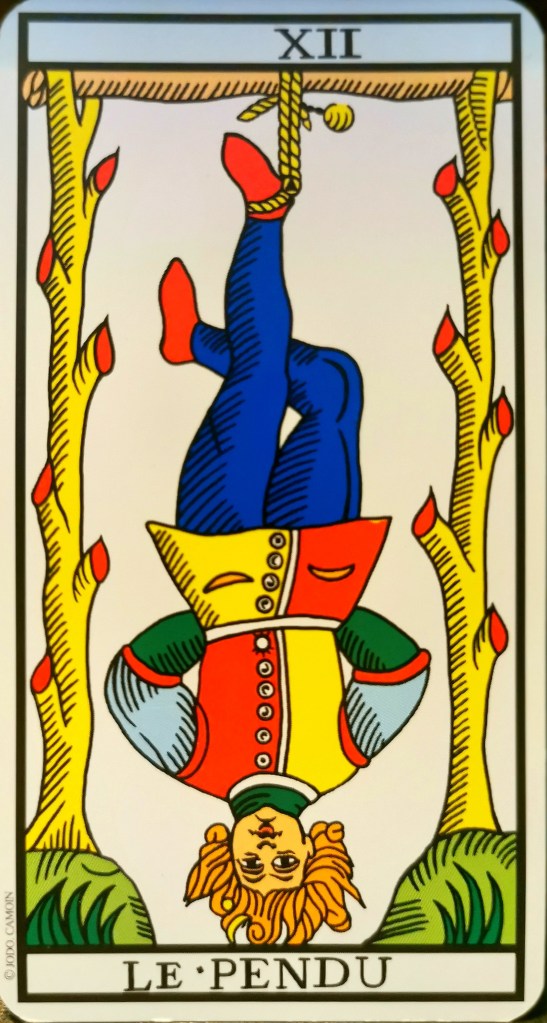
J’ai commencé par l’arcane du tarot de Thoth ce qui était le plus parlant et profond pour moi, non seulement parce que c’est mon premier tarot mais aussi parce que l’image me plonge directement dans une profondeur de l’arcane dans laquelle je peux la contempler. Ce qu’on appelle en anglais pathworking et qui correspond à regarder l’image de l’arcane dans un état méditatif et surtout contemplatif, est pour moi très vite induit par les images du Thoth. C’est mon moyen de prédilection de la rencontre car par expérience beaucoup s’annonce dans un état d’accueil et d’amour qui nous échappe dans le quotidien. Des choses émergent en image, en écrit ou en dessin qui par la suite prennent de l’ampleur et font sens. Pour un arcane aussi initiatique (je parle ici du Pendu qui est ma carte de l’année), la plongée dans son imaginaire est d’autant plus facilitée qu’il correspond aux Eaux matricielles de l’existence dans sa symbolique hermetico-kabbalistique (car il correspond à la lettre mem dans le système crowléen du Thoth ainsi que pour la Golden Dawn). Relié à Neptune par la suite (toujours dans une logique donnée par la Golden Dawn), les eaux prennent la dimension de ce que cette planète représente : un lien avec notre part la plus mystique et pythique. Ce qui ne veut pas dire qu’on se consacre à des choses religieuses, sacrées ou en lien avec quelconque forme de religion. Pas du tout! Notre première prêtresse ou initiatrice est la Vie même et ce qui est très beau à méditer durant une année avec l’arcane XII est de se questionner en quoi, comment et où est-ce qu’on est en train d’être ou a été initié. Qu’est-ce qui a acquis un sens plein et précieux ? Quel rapport avec les fondements de l’existence a profondément changé ? Pour moi ça a été sur deux plans: professionnellement, j’ai découvert un univers jusque là inconnu mais où la dimension humaine et sa dramatique (pour ne pas dire dramaturgie) est au centre des préoccupations. L’immersion en un univers où il faut travailler avec tant de collaborateurs divers est très nouveau pour moi et je l’ai beaucoup fui dans ma vie. Me voilà que je dois faire face à l’humain et ses individus (et je m’y inclus!) en toute leurs « tourmentes » mondaines, égocentrées, les relationnels conflictuels, la sévérité ou l’indulgence face à tout ça, ses complexions et leurs confrontations, leur jeu de cache-cache… quel spectacle ! J’y suis actrice et spectatrice et le sentiment d’une comédie me gagne et je ris, comme Harry Haller entend ce rire de Mozart à la fin de Steppenwolf.
Or, l’initiation la plus importante et belle est la grossesse. Au sens symbolique des eaux amniotiques dont parle Crowley, j’en suis devenue porteuse littéralement pour accueillir la Vie en une vie. Initiée et initiatrice. Il m’est encore tout à fait impossible de dire ce vécu si simple, qui coule de source et se fait tout seul en moi. Je n’ai qu’à le soutenir, l’accompagner, l’aider à se déployer. C’est avec la Mort, l’accueil le plus total qui soit. Cette initiation-là me laisse encore tout à fait immergée dans un océan inconnu, dans la découverte de sensations, de formes et d’un devenir qui me dépassent absolument. Là je trouve calme et apaisement. Ce rapport aussi essentiel et fondamental avec un autre être (père inclus) ouvre à l’Être, à ce qui nous relie dans les fonds les plus oubliés du quotidien. C’est ce temps de suspension où l’on réalise la simplicité et la sacralité de nos liens. Rien d’inatteignable, de secret ou d’interdit, juste ce à côté de quoi nous devons passer pour pouvoir jouer notre comédie quotidienne. Juste ça. Mon vécu du Pendu porte ce diamant-là, cette boue-là, cette croissance-là.
S’abandonner jusqu’où ?
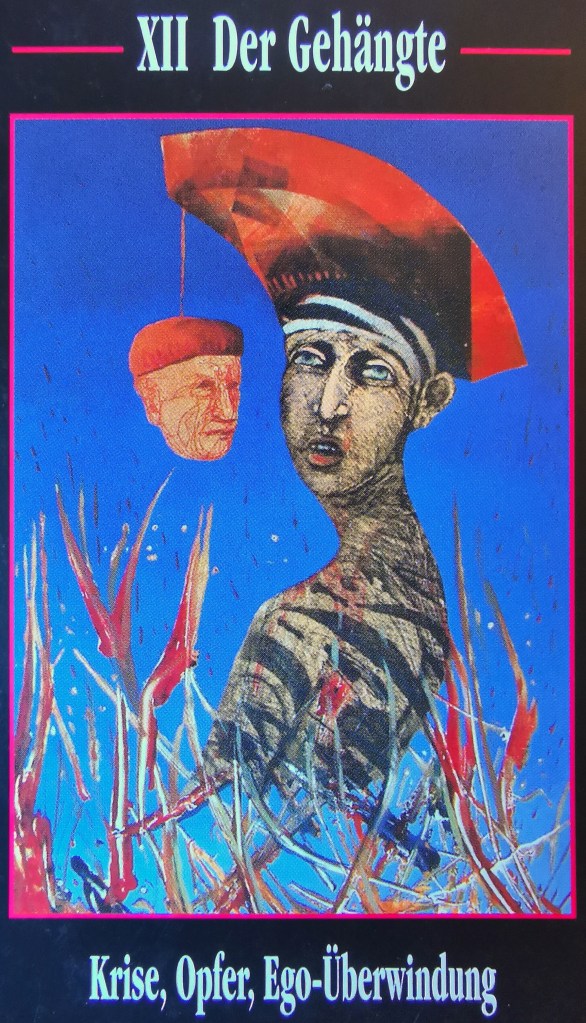
La façon très particulière dont Hüttengrund et Akron ont représenté le Pendu ouvre à une dimension qui est moins explicite, plus cachée dans l’usuelle représentation de l’Arcane. Ce qui est (sus)pendu ici est l’image du juge, du Pape de ce même tarot qui regarde la figure droit dans les yeux tout en lui obstruant tout ce qui se trouve en face d’elle. La figure nous regarde d’un air hébété, la confusion marque son visage. De plus, on dirait qu’il vient juste de se réveiller d’un grand sommeil alors qu’il se décompose sous l’action des flammes. Ici, l’arcane est clairement assimilée au feu et son action transformatrice : un Moi brûle, se détruit comme va se détruire la face accusatrice qui émane de sa propre tête. La prise de conscience de ses propres projections, de ses phantasmes qui envahissent la réalité et empêchent de voir est prévalente ici. Pour la première fois il détourne le regard des yeux sévères de la figure paternelle et découvre la face du monde nue, et la face de ses illusions dépourvues de corps, de consistance. Il meurt avec ses illusions, c’est son sacrifice, il entre dans le processus de la Mort comme métamorphose.
La carte du Pendu fait référence à cette épreuve de remise en question profonde de soi – la dissolution alchimique – d’une invitation ou contrainte de changer. Pour ma part, beaucoup de choix que j’ai fait ont porté leurs fruits et je suis dans une situation qui me satisfait. Or, sur un niveau personnel, même si j’ai renoncé à des milieux professionnels plus adaptés à mes compétences et passions, je me rends compte que je suis dans un milieu où je suis profondément étrangère. Je me suis toujours sentie ainsi, étrangère et inadapté, depuis l’école. Le moment du Pendu dure depuis un très long moment pour moi ! Le cheminement avec cet arcane révèle finalement une condition qui dure depuis bien plus d’un an et qui demande au fond d’être changée puisqu’elle engendre un répression d’une part de soi. Or, il y a une différence entre réprimer et retenir. Réprimer est une forme du refoulement, une non-acceptation d’une part du moi, d’un événement arrivé à moi impossible à assimiler à ce moment-là, cachée de sa conscience. Il s’agit de la rencontrer quand on est prêt. A contrario, retenir une part de moi est un acte conscient, stratégique et intelligent qui préserve le moi d’un milieu où cette part ne rencontrerait que méprise et mépris ou du moins incompréhension de ses besoins. Vivons heureux, vivons cachés… vraiment ? N’est-ce pas volontairement s’enterrer dans un échec du moi qui trouverait sa place dans le monde, s’épanouirait en lui et y apporterait son bien ? Le masque au travail notamment peut paradoxalement servir à cela : pour le bien d’une entreprise et d’une équipe, des parts de moi n’interviennent pas afin de préserver une cohésion et une unité. Mais jusqu’où cela peut aller ? Le Pendu, surtout au sein de l’Akron Tarot, questionne la face du Pape dans sa moralité conditionnée, n’ayant pas connu de remise en question et ne veut pas la connaître tellement elle est institutionnalisée et crée de la cohésion, de la sécurité, mais aussi de la répression et de la retenue. Jusqu’où suis-je prête à aller pour soutenir l’équipe ? Suis-je vraiment en phase avec notre entreprise à tous et les modes de préservation de cette entreprise (au sens très très large, l’oikos, la maison et sa gouvernance, d’où vient le mot l’économie, organise toute notre sécurité matérielle) ? Comme dans toute dynamique de groupe, il y a un effet meute qui m’a, à titre personnel, toujours dégoûtée et mis très mal à l’aise. Un groupe, une meute peut être cruelle avec un individu qui ne correspond plus à ses valeurs et se trouve rejeté, incompris et coupé des liens affectifs qui le nourrissaient. Là aussi des enjeux de pouvoirs et d’ego peuvent se jouer de façon injustes. Être dans un groupe est une concession déjà difficile pour certains, mais on apprend le détachement vis-à-vis d’autrui (ce qui n’empêche en rien l’empathie de demeurer en fond) et vis-à-vis de soi. Ces liens affectifs qui s’y jouent se façon encore si inconsciente durant l’enfance et l’adolescence, peuvent être conscientisés à l’âge adulte et on se rend compte à quel point on vivait dans un 8 d’Epée et le Diable au sein de ses besoins.
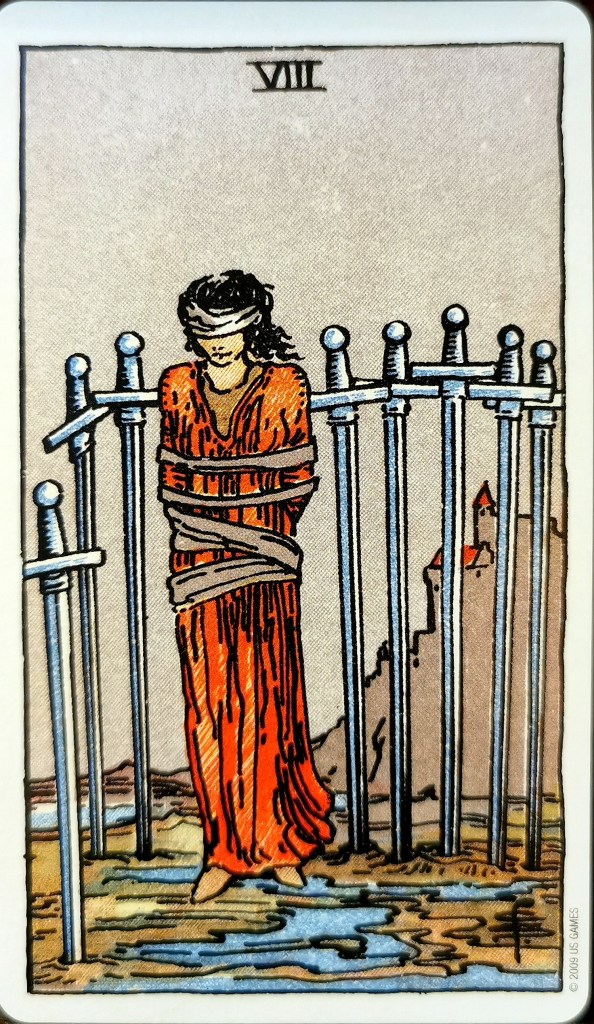
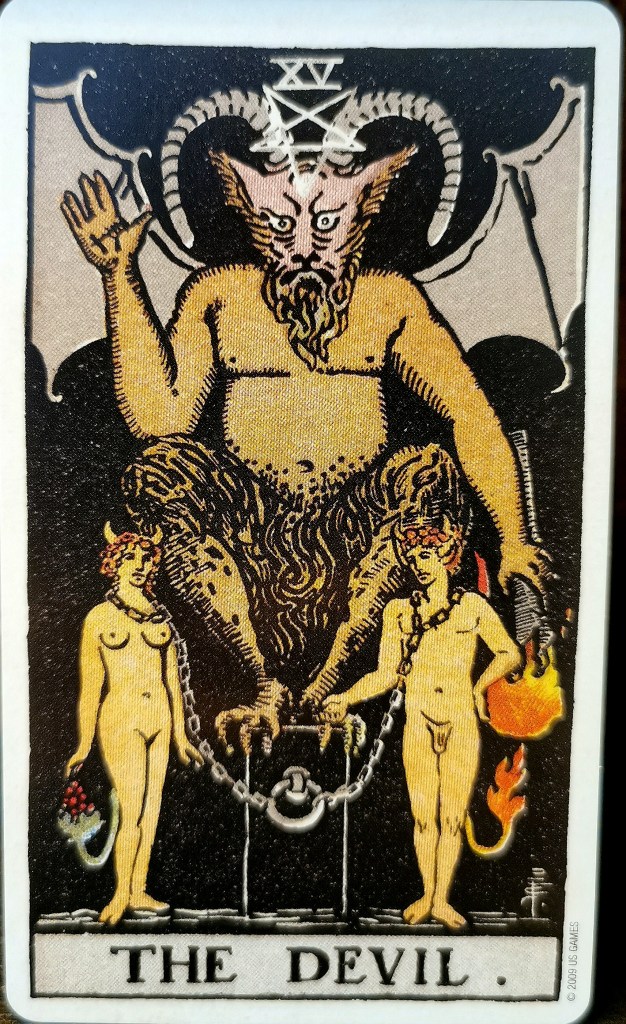
Ces liens sont à double tranchant : ils puisent dans des besoins fondamentaux et il devient facile de croire que certains liens nous sont indispensables… jusqu’à ce qu’on trouve la clé du cadenas…
Si je dois faire le bilan de mon année du Pendu car mon anniversaire est très proche, je dirais que le sens de la retenue avec ses limites m’est donné comme épreuve, puis aussi la conscientisation des faux besoins affectifs. Avec la prise de conscience de mes limites, la répression des parts du moi émergent impulsivement et se manifestent pour affirmer une contre-posture, là les liens deviennent serrés et je le rends compte que je me suis privée de liberté. En tirant une carte du magnifique Daemon Tarot afin d’avoir un conseil sur comment donner forme à ses manifestations rebelles, Ronove est sorti et son pouvoir rhétorique : la face la plus hideuse et grossière que vous puissiez imaginer (l’image de la carte en est encore trop jolie) séduit par son langage éloquent et l’esprit qui l’habite, voilà son pouvoir et l’effet de surprise hypnotisant qu’il exerce. Bon conseil de cette « sagesse interdite » et très ambigüe. Sachant que la face hideuse correspond à la perception du milieu auquel elle ne convient pas. C’est un face qui dit vrai mais qui est belle dans un autre milieu qui la perçoit différemment. Or, la parole en ce cas, dit-elle le vrai ? Elle dit pour vaincre, convaincre, trouver un chemin pour vivre en milieu inadapté. Est-ce viable ? C’est peut-être ça, vivre avec ses démons et croire qu’on y est obligé.
Une autre correspondance
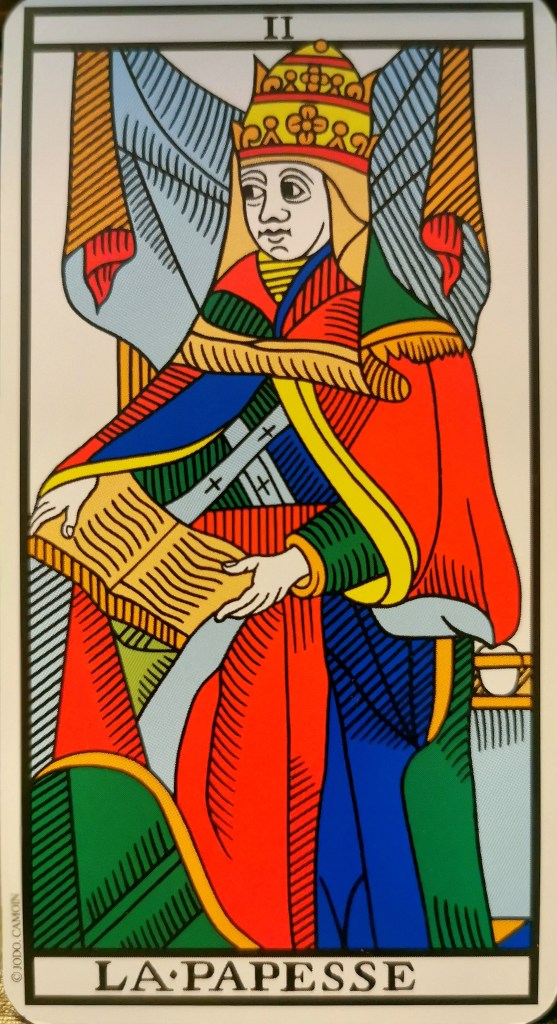
Non seulement L’Impératrice est numérologiquement liée au Pendu comme sa somme et donc sa résultante mais l’Arcane la plus proche encore est La Papesse ou La Grande Prêtresse. Dans les deux décans que forment les Arcanes Majeurs, on peut observer des parallèles intéressants : L’Arcane I correspondrait à La Roue de Fortune, La Papesse au Pendu, L’Impératrice à la Mort, etc.. C’est un système rencontré dans La Voie du Tarot (mais bien d’autres en parlent aussi comme l’excellent ouvrage de Caitlin Matthews Untold tarot) et que je trouve très intéressant à explorer. Ainsi, le Pendu dans son mouvement gravitationnel vers le bas, cette faille qui s’ouvre dans la terre tout en ayant le pied suspendu dans le ciel, trouverait un pendant dans la Papesse dont la tête prolongée par la mitre va au-delà du voile, voire même au-delà du cadre de la carte.
The calculation(s)
What is a card of the year? Here I offer my own thoughts, based on various influences, notably Akron and Banzhaf (Der Crowley Tarot) and Jodorowsky and Costa (La voie du tarot). The choice of the card of the year is the result of the sum of the following numbers: the day, the month of one’s birthday and the current year. Example: 22 + 08 + 2025 or 2+2+0+8+2+0+2+5. The two do not give the same result, either 12 or 21, so there is an inversion. This will be important later on in our reflection. For now, let’s think about these two calculation principles. The first does not take into account the simple number (2+0+2+5) but its multiplicity and the magnitude (2025) that comes with it. For my part, I find it interesting to take this multiplicity into account and let it speak as a state of affairs, a sum, if you will, of our journey so far concidering the whole time preceding the present moment and even our existence like various currents mixed together and becoming one. It is a complex whole, a composition that we can meditate on through different questions. For example: What decisions, events and people have led me here? Now that I am here, how do I feel? How do I want to continue? How can I describe my situation and what is the best course of action for me? In the example (the first calculation), we have the sum of 12 or 3, which corresponds to The Hanged Man and The Empress. Akron and Banzhaf talk about a personal card (12) and an essential card (3) (not directly in the context of a card of the year but a life-card, so the year is the year of birth and not the current year), which I would also transpose here: The Hanged Man would be my current situation and the issues that are clearly present: a challenge to face, a new attitude to adopt, some kind of initiation (in the broadest sense), discovering unknown inner resources, diving into one’s own dark waters, etc. The Empress, on the other hand, would be the sum of the singles as a simple number, that is, what is most essential. In a way, it is by traversing the challenges of the Hanged Man that I develop that energy within myself. I know that this view contradicts the following view: to see the first 10 arcana as the mundane expression of human existence and the next 10 as the more spiritual, profound, even essential part. However, The Empress is not empress in mundane reality; she is essence like any arcana and presents a fundamental disposition to existence: creation and growth. In The Hanged Man, I am not drowning, but I grow, am evolving in my own deepest, blackest or at least amniotic waters. The essential card provides the principle to be deployed, while the personal card gives an overview of the situation and context that will provide the essence with its terrain for growth.
The second method of calculation gives us the personal number 21 and the essential number 3 again. The situation would be The World and the essence The Empress. That is to say, an accomplishment, a harmony found, a cycle completed or to be completed that can be enjoyed and in which one can evolve. In a way, The World presents us with an achievement, something fully manifested in the world. The Empress would represent the essence of growth, not in dark waters, the invisible interior, in a deeply transformative challenge, but in a more conscious and accomplished context. This could be a certain activity that can finally come to fruition because the workshop, the business, the home or the place has been found and built.
So how do you choose between the two methods of calculation? Do you have to choose? In fact, the calculations basically involve the same cards but in a different ratio. When calculating multiplicity, we remain closer to appearances, direct sensations, and a path that takes various influences into account and quantifies them. In the second calculation, we perceive the more hidden issues, what we are striving for internally, and we no longer burden ourselves with too many details and influences that cause us to lose sight of the big picture. I think both paths are interesting to consider and connect. These are still very abstract considerations that need to be appropriated and refined in each person’s personal situation. It is only a sketch of a composition to be accomplished for oneself and with oneself.
Walking alongside an arcane for a year gives us a special opportunity to encounter it, to make sense of it and then unravel that meaning: from the most concrete to the most ethereal, we can delve deeper, question ourselves, be enchanted, annoyed, surprised, etc. In a way, we build a relationship with the arcane in question. It is a real journey with it over four seasons, with moments of complicity and phases where the arcane (once again) becomes a stranger. The different versions of various decks are a great source of inspiration and richness here, giving rise to very diverse atmospheres and aspects. The way in which artists bring the figure of the arcane back into the spotlight is very personal, and it makes sense to do the same. This particular work with the tarot can be very creative and gives rise, in one way or another, to our own figure or form through which we manifest this arcane. This article becomes a work in progress in the sense that during the year different aspects of the arcane manifest themselves, or rather, are brought to light. For the question always remains open in working with the tarot, and this is what makes it both ambivalent and so powerful at the same time:
Does it reveal or does it provoke what manifests itself?
Resembling a diary, this work reflects on the importance we attach to the unfolding of meaning and, above all, its power. It is a work that goes much deeper than a search for meaning that remains at a discursive level, a false stability that is useful in the early stages of learning but ultimately superficial. At this level, we have not yet touched on the inner resonance of the card. However, the card of the year invites us to live with the arcane, to explore it in all moments of life: in dreams/sleep, at surprising moments in everyday life when we link a situation or a feeling to it, at moments of great questioning, we seek its wisdom, its shadow, its symbolism sometimes appears in flashes or launches us into rather obscure considerations. In any case, it is part of our home, our intimate abode for a year, like a traveller who stays there for a given time before moving on. And we take the time to encounter this stranger.
How can we bear witness to this? This testimony helps us to delve deeper and explore the asset in its own language. So, initially, meaning is woven together with symbolic and therefore enigmatic elements…
The manifested symbols
I started with the Thoth Tarot arcana, which was the most meaningful and profound for me, not only because it was my first tarot deck, but also because the image plunges me directly into the depths of the arcana, where I can contemplate it. What is known as pathworking, which involves looking at the image of the arcana in a meditative and, above all, contemplative state, is very quickly induced in me by the images of the Thoth. It is my preferred means of encounter because, in my experience, much is revealed in a state of openness and love that escapes us in everyday life. Things emerge in images, writing or drawings, which then take on greater significance and meaning. For such an initiatory arcane (I am referring here to the Hanged Man, which is my card of the year), diving into its imagery is made all the easier as it corresponds to the matrix waters of existence in its hermetic-kabbalistic symbolism (as it corresponds to the letter mem in Crowley’s Thoth system and for the Golden Dawn). Subsequently linked to Neptune (again, according to the logic of the Golden Dawn), the waters take on the dimension of what this planet represents: a link to our most mystical and prophetic side. This does not mean that we devote ourselves to religious or sacred matters or to any form of religion. Not at all! Our first priestess or initiator is Life itself, and what is very beautiful to meditate on during a year with Arcanum XII is to ask ourselves in what way, how and where we are being or have been initiated. What has acquired full and precious meaning? What relationship with the foundations of existence has profoundly changed? For me, it has been on two levels: professionally, I have discovered a universe that was previously unknown to me, but where the human dimension and its drama (not to say dramaturgy) are at the centre of concerns. Immersing myself in a world where I have to work with so many different people is very new to me, and I have avoided it a lot in my life. Now I have to deal with people (and I include myself!) and their worldly, egocentric ‘torments’, their conflictual relationships, their severity or indulgence in the face of all this, their complexions and their confrontations, their game of hide-and-seek… What a spectacle! I am both an actress and a spectator, and the feeling of a comedy overtakes me, and I laugh, just as Harry Haller hears Mozart’s laughter at the end of Steppenwolf.
However, the most important and beautiful initiation is pregnancy. In the symbolic sense of the amniotic waters Crowley speaks of, I have literally become a vessel to welcome Life into a life. Initiated and initiator. It is still completely impossible for me to describe this simple experience, which flows naturally and happens all by itself within me. All I have to do is support it, accompany it, help it unfold. It is with Death that the most complete welcome is given. This initiation still leaves me completely immersed in an unknown ocean, discovering sensations, forms and a future that is completely beyond me. There I find calm and peace. This essential and fundamental relationship with another being (including the father) opens us up to Being, to what connects us in the most forgotten depths of everyday life. It is this time of suspension when we realise the simplicity and sacredness of our bonds. Nothing unattainable, secret or forbidden, just what we must pass by in order to play our daily comedy. Just that. My experience of the Hanged Man carries that diamond, that mud, that growth.
How far should one surrender?
The very particular way in which Hüttengrund and Akron depicted The Hanged Man opens up a dimension that is less explicit, more hidden in the usual representation of the Arcana. What is (sus)pended here is the image of the judge, the Pope from the same tarot deck, who looks the figure straight in the eye while blocking everything in front of her. The figure looks at us with a dazed expression, confusion marking his face. Moreover, he looks as if he has just awakened from a deep sleep as he decomposes under the action of the flames. Here, the Arcana is clearly assimilated to fire and its transformative action: an ego burns, destroys itself, just as the accusing face emanating from his own head will be destroyed. The awareness of one’s own projections, of one’s fantasies that invade reality and prevent one from seeing, is prevalent here. For the first time, he averts his gaze from the stern eyes of the father figure and discovers the naked face of the world and the face of his illusions, devoid of body and substance. He dies with his illusions; this is his sacrifice. He enters the process of Death as a metamorphosis.
The Hanged Man card refers to this profound self-questioning process – alchemical dissolution – an invitation or compulsion to change. For my part, many of the choices I have made have borne fruit and I am in a situation that satisfies me. However, on a personal level, even though I have given up professional environments that were more suited to my skills and passions, I realise that I am in an environment where I feel profoundly alien. I have always felt this way, alienated and maladjusted, ever since school. The Hanged Man phase has lasted a very long time for me! The journey with this arcane ultimately reveals a condition that has lasted for well over a year and that ultimately needs to be changed, as it leads to the repression of a part of oneself. However, there is a difference between repressing and holding back. Repressing is a form of denial, a non-acceptance of a part of the self, of an event that happened to me that was impossible to assimilate at the time, hidden from my consciousness. It is a matter of encountering it when one is ready. On the other hand, holding back a part of oneself is a conscious, strategic and intelligent act that protects the self from an environment where that part would only encounter misunderstanding and contempt, or at least a lack of understanding of its needs. Live happily, live hidden… really? Isn’t this deliberately burying oneself in a failure of the self that would find its place in the world, flourish in it and bring good to it? Paradoxically, wearing a mask at work can serve this purpose: for the good of a company and a team, parts of myself do not intervene in order to preserve cohesion and unity. But how far can this go? The Hanged Man, especially in the Akron Tarot, questions the Pope’s conditioned morality, having never been challenged and not wanting to be challenged because it is so institutionalised and creates cohesion and security, but also repression and restraint. How far am I willing to go to support the team? Am I really in tune with our collective enterprise and the ways in which it is preserved (in the very broad sense, the oikos, the home and its governance, from which the word economy derives, organises all our material security)? As in any group dynamic, there is a herd mentality that, personally, has always disgusted me and made me very uncomfortable. A group, a herd, can be cruel to an individual who no longer fits in with its values and finds themselves rejected, misunderstood and cut off from the emotional ties that nourished them. Here too, issues of power and ego can come into play in unfair ways. Being part of a group is already a difficult compromise for some, but we learn detachment from others (which in no way prevents empathy from remaining in the background) and from ourselves. These emotional bonds, which are formed so unconsciously during childhood and adolescence, can be brought to consciousness in adulthood, and we realise how much we were living in an 8 of Swords and the Devil within our needs.
These ties are double-edged: they draw on fundamental needs, and it becomes easy to believe that certain ties are indispensable to us… until we find the key to the padlock…
If I had to take stock of my year of the Hanged Man, as my birthday is very close, I would say that the sense of restraint with its limitations is given to me as a test, as well as the awareness of false emotional needs. With the awareness of my limits, the repression of parts of myself emerge impulsively and manifest themselves to assert a counter-posture, where bonds become tight and I realise that I have deprived myself of freedom. Drawing a card from the magnificent Daemon Tarot to get advice on how to give shape to these rebellious manifestations, Ronove came out with his rhetorical skill: the most hideous and crude face you can imagine (the image on the card is still too pretty) seduces with its eloquent language and the spirit that inhabits it. This is his power and the hypnotising surprise effect he exerts. Good advice from this ‘forbidden wisdom’ and very ambiguous. Knowing that the hideous face corresponds to the perception of the environment to which it does not suit. It is a face that tells the truth but is beautiful in another environment that perceives it differently. But in this case, does speech tell the truth? It speaks to conquer, to convince, to find a way to live in an unsuitable environment. Is this viable? Perhaps this is what it means to live with one’s demons and believe that one is obliged to do so.
Another correspondance
Not only is The Empress numerologically linked to The Hanged Man as its sum and therefore its result, but the closest Arcana is The High Priestess. In the two decans formed by the Major Arcana, we can observe some interesting parallels: Arcana I corresponds to The Wheel of Fortune, The High Priestess to The Hanged Man, The Empress to Death, etc. This is a system found in The Way of the Tarot (but many others also mention it, such as Caitlin Matthews’ excellent book Untold Tarot), which I find very interesting to explore. Thus, the Hanged Man, in his gravitational downward movement, this fault that opens in the earth while his foot is suspended in the sky, would find a counterpart in the High Priestess, whose head, extended by the mitre, goes beyond the veil, even beyond the frame of the card.
One looks up from the holy book, as if to reflect on what she is reading, while the other looks directly at the viewer, as if holding her breath. Both are in a state of introversion, but the Hanged Man is undergoing an ordeal, while the High Priestess is in contemplation. Both Arcana represent the number 2, which in Jodorowsky and Costa’s system is a time of accumulation of energy or everything needed to grow and create in the 3. Whereas the High Priestess is bound by a costume and ceremonial and communal attributes, the Hanged Man appears in clothes that are seemingly without status and with dishevelled hair. He does not follow a spiritual path dictated by any religion or order; on the contrary, he could even be the punished rebel. The Hanged Man’s initiation is internal, deeply solitary, seeking no recognition. The High Priestess’s initiation, on the other hand, is part of a community that shares values, fundamental texts and moral rules, with group functioning imposed on the individual. The Hanged Man seems to me to be more radical in his approach. In a way, he is alone facing the Universe, whose Law imposes itself on him, forcing him to surrender to what truly has authority over him. This reminds me of an alchemical adage, I think: ‘Transform nature with the laws of nature’. First of all, we must experience these laws, encounter them in order to master the art of shaping nature – and what nature is is another question altogether. It is not a question of imposing one’s power or will, but first of encountering one’s power, understanding what will is, what desire is, what lack is, what love is. This is an operation that goes beyond scholarly knowledge and conceptual discourse (no less interesting), it is an inner, intimate encounter that does not pass through the exterior. What the Hanged Man loses, it seems to me, is his exteriority, the person he embodies in reality in order to merge with the inner ocean. For my part, this call from within grows stronger and stronger as the world around me demands my attention with its concerns. There is a constant balancing act, a constant harmony to be found between the inner and the outer. Water, in its elemental power, dissolves and echoes for me a need for internalisation that leads to forgetting oneself, remaining in what is, following silent teaching, inner guidance without any instruction. I experience ‘movement within oneself’, the soul, that absolute which carries within itself its principle of being. It is a strange experience, all the more disconcerting because when one returns to one’s exteriority, one wonders what one is doing there.
L’une lève le regard du livre saint, comme pour songer sur ce qu’elle lit, l’autre regarde le regardeur directement, comme en apnée. Les deux sont dans un état d’introversion, mais le Pendu l’est dans l’épreuve tandis que la Papesse l’est dans la contemplation. Les deux Arcanes sont représentants du chiffre 2 qui est dans le système de Jodorowsky et Costa un temps d’accumulation d’énergie ou de tout ce qu’il faut afin de croître et de créer dans le 3. Là où la Papesse est tenue par un costume, des attributs cérémoniaux et communautaires, le Pendu se montre dans ses habits a priori sans statut et échevelé. Il ne s’inscrit pas dans un chemin spirituel ordonné par une religion ou un ordre quelconque, au contraire il pourrait même en être le contestataire puni. L’initiation du Pendu est intérieure, profondément solitaire qui ne cherche aucune reconnaissance. Celle de la Papesse s’inscrit au contraire dans une communauté qui partage des valeurs, des textes fondamentaux et de règles morales, un fonctionnement de groupe s’impose à l’individu. Le Pendu me paraît plus radical dans sa démarche. Quelque part il est seul face à l’Univers dont la Loi s’impose à lui, le contraint à s’abandonner à ce qui réellement fait autorité sur lui. Cela me fait penser à un adage alchimique me semble-t-il : « Transformer la nature avec les lois de la nature ». Tout d’abord faut-il donc éprouver ces lois, les rencontrer afin de pouvoir maîtriser l’art de former la nature – et ce qu’est la nature est encore tout une autre question. Il n’est pas question d’imposer son pouvoir, sa volonté, mais de d’abord rencontrer son pouvoir, comprendre ce qu’est la volonté, ce qu’est le désir, le manque, l’amour. C’est une opération qui est au-delà d’une connaissance savante, d’un discours conceptuel (non moins intéressant), c’est une rencontre intérieure, intime ne passant pas par l’extériorité. Ce que le Pendu perd, me semble-t-il, c’est son extériorité, la personne qu’il incarne dans la réalité afin de se fondre dans l’océan intérieur. Pour ma part, cet appel de l’intérieur est de plus en plus fort au fur et à mesure que le monde autour de moi me sollicite avec ses préoccupations. Il y a comme un constant équilibrage, une constante concordance à trouver entre intérieur et extérieur. L’eau dans son pouvoir élémentaire dissout et fait écho pour moi à un besoin d’intériorisation qui amène à s’oublier en soi, demeurer en ce qui est, suivre l’enseignement silencieux, la guidance intérieure sans aucune instruction. J’expérimente le « mouvement en soi », âme cet absolu qui porte en lui-même son principe d’être. Etrange expérience et d’autant plus déconcertante qu’en revenant à son extériorité, on se demande ce qu’on fait là.
Certaines relations pourtant font écho à cette profondeur et si on regarde bien, le monde entier est bâti sur ce fond d’âme, ignoré la plupart du temps, enseveli par des enjeux égotiques. Plus je creuse le Pendu, plus l’écart entre lui et le Monde s’agrandit, alors que numériquement, donc essentiellement, ils sont liés. Pour en revenir à la Papesse qui est intrinsèquement liée au Pendu, son silence, son intériorisation sont aux antipodes d’une vie focalisée sur l’extérieur. Il y a comme un équilibre qui s’instaure, où il faut apprendre à être dans une justesse entre l’expérience intérieure et celle de l’extérieur, entre indifférence et implication.
Nous sommes face à une image fixe mais est-ce que le Pendu ne serait pas pris par un balancement qui n’est pas de son essor ? et que tout l’enjeu est d’ateindre cette immobilité qui n’est que parfait équilibre ? Fausse immobilité puisqu’elle est maîtrise de mouvements advenants, intérieurs comme extérieurs, comme quant on tient l’équilibre sur une jambe. Le mouvement tient l’immobilité paradoxalement.
Some relationships, however, echo this depth, and if we look closely, the whole world is built on this foundation of the soul, mostly ignored, buried by egotistical issues. The more I delve into the Hanged Man, the greater the gap between him and the World becomes, even though numerically, and therefore essentially, they are linked. Returning to the High Priestess, who is intrinsically linked to the Hanged Man, her silence and introspection are the antithesis of a life focused on the outside world. A balance is established, where one must learn to strike a balance between inner and outer experience, between indifference and involvement.
We are faced with a still image, but could it be that the Hanged Man is caught in a swing that is not of his own making? And that the whole challenge is to achieve this immobility, which is nothing more than perfect balance? It is a false immobility, since it is the control of movements, both internal and external, as when one balances on one leg. Paradoxically, movement maintains immobility.
 cefitarot
Partagez vos pensées !